Act four · The hills
Litchfield Hills and quiet New England
The state's northwest is its slowest, most forested face: the Litchfield Hills, with their town greens and white churches, the Housatonic River and the Appalachian Trail, covered bridges and waterfalls, and two singular houses that show Connecticut's eccentric and modern sides.
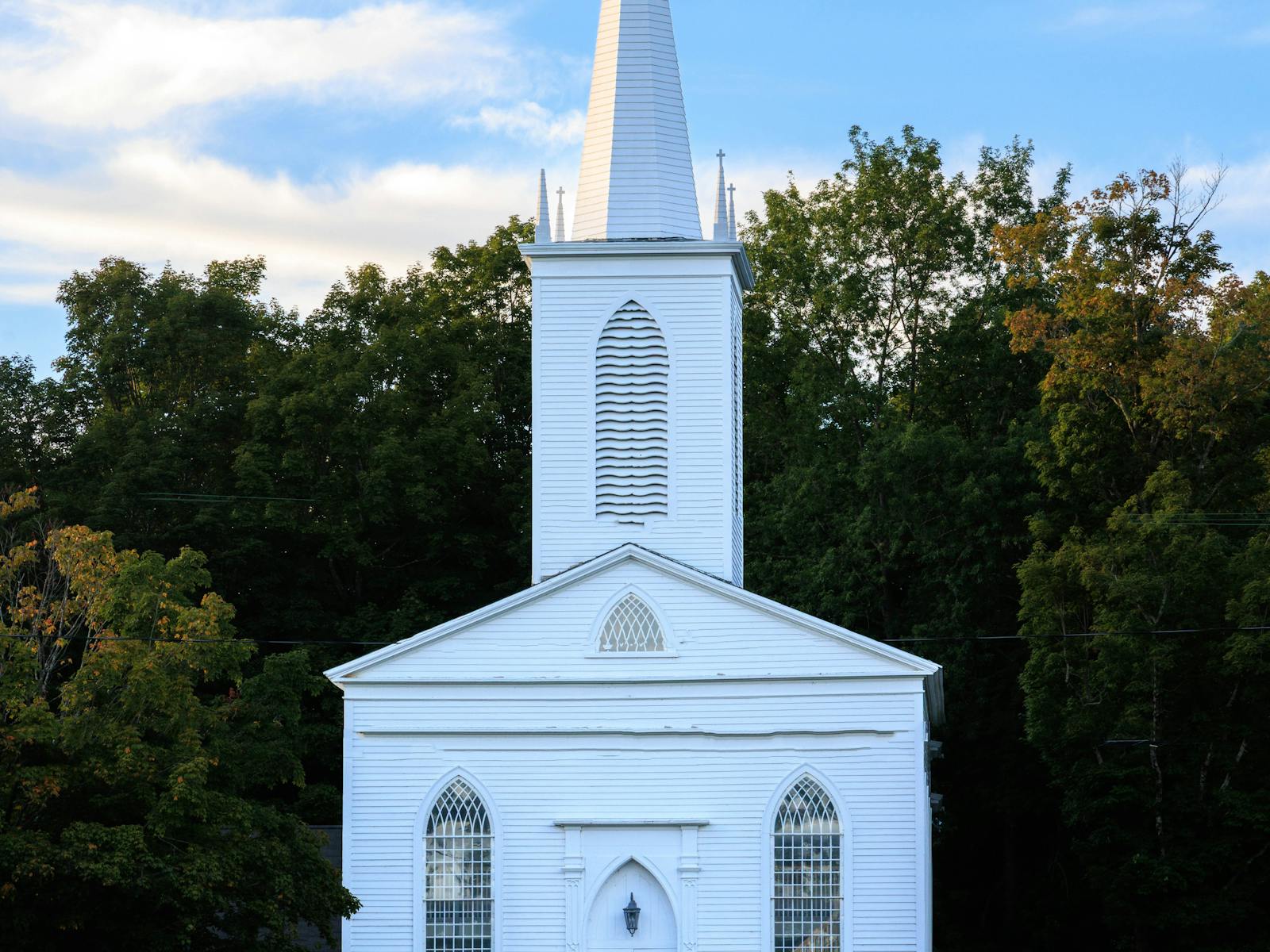
The town green and old New England
The Litchfield Hills hold the classic image of inland New England: villages built around a town green, white-steepled churches, old clapboard houses, and stone walls running through the woods. Litchfield itself is the archetype, and the surrounding towns keep the same quiet, historic scale.
The town green is more than scenery here; it is the old organizing idea of the New England community — a shared public center for church, town meeting, and daily life.
Forests, falls, and the trail
This is also the state's outdoors. The Housatonic River runs south through the hills, the Appalachian Trail crosses the northwest corner for some fifty miles, and parks like Kent Falls bring waterfalls and woods within an easy drive.
The West Cornwall Covered Bridge over the Housatonic is the signature image of the region — a working nineteenth-century covered bridge in a forest setting.
The eccentric and the modern
Two singular houses show the quieter state's range. Above the Connecticut River, Gillette Castle is the stone folly built by the actor William Gillette, famous for playing Sherlock Holmes — a medieval fantasy in the woods. In New Canaan, the Glass House of 1949 by Philip Johnson is a landmark of modern architecture, now held by the National Trust for Historic Preservation.
One looks back to a romantic past, the other forward to mid-century modernism; together they show Connecticut as a place of architectural imagination, not only colonial memory.
The quiet edge
If Hartford is self-government, New Haven is knowledge, and the coast is the sea, the Litchfield Hills are simply the slow part — the forests, rivers, and small greens that show Connecticut at its most rural and unhurried.
It is the side of the state that feels furthest from the metropolitan corridor, and the easiest place to understand why so much of Connecticut still reads as old New England.
Sources
Reviewed source trail
- Visit Connecticut — Litchfield Hills — checked 2026-06-19
- Appalachian Trail Conservancy — Connecticut — checked 2026-06-19
- The Glass House (National Trust for Historic Preservation) — checked 2026-06-19